
Burke County Court Records After Arrest
The Burke County arrest-to-court path has three records streams. The first is the jail record in the P2C Jail Inmates portal. The second is the court case record in the North Carolina eCourts Portal or through the Burke County clerk. The third is the prosecution file handled by Prosecutorial District 36, District Attorney Scott Reilly's office.
The jail roster may show arrest date, booking agency, primary charge, bond fields, docket number, and a court date when those fields are enabled. That does not mean the booking charge is the final court charge. Formal court records after an arrest can show charges that were changed, reduced, dismissed, added, indicted, or resolved by plea, trial, or another disposition. For custody and booking details, use jail inmate records. For booking-photo questions, use jail roster mugshots.
The statewide court-search entry point is visible in the official North Carolina eCourts Portal capture below.
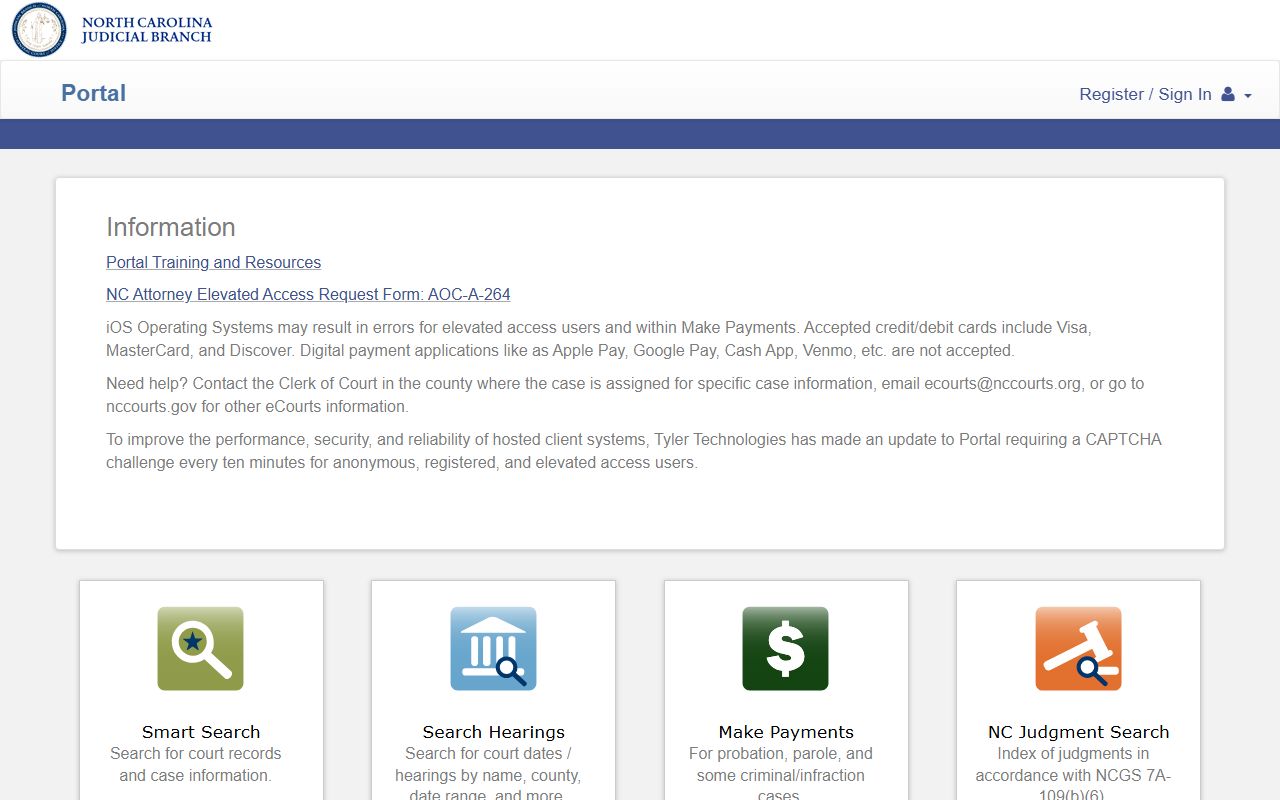
Use eCourts for case and hearing searches, then contact Burke County courthouse offices when an older, restricted, or hard-to-match case needs clerk routing.
Find Burke County Arrest Court Records
Start with the jail roster only if the person is currently in custody and you need exact spelling, booking agency, arrest date, primary charge, docket number, or a listed court date. Then move to eCourts for the case record. The portal requires JavaScript and cookies, and Tyler warns that a CAPTCHA challenge appears every ten minutes for anonymous, registered, and elevated access users.
- Open the P2C Jail Inmates portal and capture the defendant's name spelling, booking agency, arrest date, charge wording, and docket number if shown.
- Open the NC eCourts Portal and use Smart Search for the defendant name, case number, citation number, or other available identifier.
- Use Search Hearings to check court dates by name, county, and date range when those search controls are available in the browser session.
- Open the case and compare the formal court charge list with the booking charge list on the jail roster.
- For older or hard-to-find matters, contact Burke County Courthouse through the Judicial Branch directory at 828-433-3200.
The N.C. Judicial Branch court records page also points users to criminal background checks and expunction information. The NCDAC offender search is not a statewide arrest-history database; it covers state prison, probation, parole, and historical DAC records and says it does not include county jail information.
eCourts Fields After Arrest
The public portal functions as the statewide case-search route for court records after a Burke County arrest. Its visible public controls are modules rather than one simple jail-style roster table.
| Field / Control | Type | Required | Options / Format Notes |
|---|---|---|---|
| Smart Search | Search module | Unspecified | Search for court records and case information. |
| Search Hearings | Search module | Unspecified | Search for court dates and hearings by name, county, date range, and more. |
| Make Payments | Payment module | Conditional | For probation, parole, and some criminal or infraction cases. The portal notice lists Visa, MasterCard, and Discover and says digital payment apps are not accepted. |
| NC Judgment Search | Search module | Unspecified | Judgment index under N.C.G.S. 7A-109(b)(6). |
| Register / Sign In | Account controls | Optional or conditional | Registration or elevated access may be needed for expanded access, but public anonymous searching is offered. |
| CAPTCHA | Challenge | Yes during use | The portal notice says CAPTCHA appears every ten minutes for anonymous, registered, and elevated users. |
Filed Charges After Jail Arrest
After a Burke County arrest, booking may occur before the final shape of the prosecution is clear. North Carolina criminal cases can begin through law-enforcement charges, magistrate processes, citations, warrants, orders for arrest, or other criminal process. Felony matters may later be presented to a grand jury. The District Attorney represents the State and makes prosecution decisions within the court process.
| Document or Process | Common Source | What It Does | Why It Matters After Arrest |
|---|---|---|---|
| Magistrate order or warrant | Judicial official or law-enforcement process | Starts or supports the criminal process that can lead to booking. | May explain why the person was arrested and why a court file exists. |
| Citation or criminal summons | Law enforcement or court process | Charges a person without necessarily creating the same custody timeline. | May create a court record even when the person is not held in jail. |
| Prosecutor-filed charge | District Attorney | Defines what the State is prosecuting in court. | May differ from the booking charge shown by P2C. |
| True bill of indictment | Grand jury | Moves felony prosecution forward after grand-jury action. | Appears as a local P2C warrant/wanted type and belongs to the court/prosecution stage. |
Charge Status After Arrest
Charge status changes as the court case develops. A booking charge may be only the first visible accusation. The eCourts case and clerk file are the better sources for the current court charge, hearing status, and outcome.
| Status | What It Means | How to Read It |
|---|---|---|
| Pending | The charge is still open in the court process. | Check hearing dates, bond conditions, and any new filings. |
| Amended / Reduced | The filed charge changed from the original allegation. | Do not rely on the jail roster alone because the roster may preserve earlier booking language. |
| Dismissed | The court or prosecutor ended the charge without a conviction. | Dismissal is not the same as expunction, and public visibility may still require a separate legal process. |
| Indicted / True Bill | A grand jury returned a true bill for prosecution. | Commonly tied to felony prosecution, and it may appear in warrant or court records. |
| Convicted | The case ended in a guilty plea, verdict, or other conviction entry. | Sentenced state custody should be tracked through NCDAC after admission. |
Bond After Burke County Arrest
North Carolina uses pretrial release conditions rather than one single bail method. The P2C roster can display total bond amount and per-charge bond fields, including bond type, status, and amount. Those fields are useful, but the controlling release order is the court or judicial order, and holds or detainers can prevent release even when a local bond amount appears online.
| Bond or Release Type | How It Works |
|---|---|
| Written promise to appear | Release based on a promise to return to court. |
| Custody release | Release to a responsible person or custodian. |
| Unsecured bond | No money is posted up front, but a stated amount becomes owed if the defendant fails to comply. |
| Secured bond | Cash, property, or surety must secure the bond before release. |
| Cash or surety bond | Cash is posted directly, or a licensed surety posts the bond. |
| No-bond hold | The person is not eligible for release on that matter until a court changes the condition or the hold clears. |
Burke County Jail does not publish a complete bond-posting guide, accepted payment list, or bond-posting hours on the jail contact page. Call 828-764-9590 before trying to post bond. For the court file, use Burke County Courthouse or clerk contacts from the Judicial Branch directory.
Warrants and Arrest Court Records
Burke County and Morganton DPS use the P2C Wanted Persons module, labeled Warrants in the portal. A warrant entry can explain why a person was arrested, why they are in jail, or why release is delayed by another active matter. The warrant search fields include first, middle, and last name; age; full address; agency; type; charge; race; and gender.
| Local P2C Warrant Type | Meaning in Plain English |
|---|---|
| WARR Warrant | A warrant can authorize arrest and lead to jail booking. |
| OFA Order for Arrest / JOFA Judges Order for Arrest | A court order may require arrest for a pending or missed court matter. |
| MO Magistrate Order | A magistrate order can begin or support the criminal process. |
| TB True Bill of Indictment | Grand-jury action associated with felony prosecution. |
| PROB Probation Violation | A supervision matter that can create a hold or affect release. |
| CS Criminal Summons / SUB Criminal Subpoena | Court process that may appear in records even when custody status differs. |
Online wanted-person data can be incomplete or delayed. For court orders and bench-warrant questions, contact the courthouse or an attorney rather than relying only on a web listing.
Burke County Charges vs Convictions
An arrest and a charge are accusations, not a conviction. The court record should be read by stage, charge status, and disposition. That distinction matters for background checks, employment questions, housing questions, court compliance, and personal record cleanup.
| Charge | Conviction | |
|---|---|---|
| Stage | Accusation or filed criminal count. | Outcome after plea, verdict, or qualifying adjudication. |
| Proof | Can begin from probable cause or criminal process. | Requires a conviction-level court result. |
| Record Source | Jail roster may show booking charge; eCourts shows filed court charge. | Court disposition and sentence records are the main source. |
| Custody Link | May affect bond, holds, and hearings. | May lead to probation, jail sentence, or transfer to NCDAC state custody. |
Sealed vs Expunged Court Records
The N.C. Judicial Branch court records material points users to expunction information, but eligibility depends on the charge, disposition, criminal history, timing, and court order. A dismissal does not automatically erase every online or paper trace. A person who wants an arrest or charge removed from public view should use the North Carolina expunction process or consult an attorney.
| Sealed or Restricted | Expunged | |
|---|---|---|
| Public Visibility | Hidden from ordinary public access, depending on the order or rule. | Treated as removed from public record under the court's expunction order. |
| Agency Access | Some court or law-enforcement access may remain. | Access is limited by North Carolina expunction law and the specific order. |
| How It Happens | By rule, statute, or court order. | By filing and obtaining a qualifying expunction order. |
| Why It Matters | Restricted records may not appear in public searches. | Official agencies and third parties may need separate updates after an order. |
Background Check Considerations
Casual jail and court lookups are not the same as an FCRA-compliant background check. Court records after an arrest can be incomplete if the search misses an alias, older file, dismissed matter, sealed entry, expunction order, or county-specific record. Use official Judicial Branch criminal-background procedures for formal checks.
Important: This private site is not a consumer reporting agency and cannot be used for employment, tenant, credit, insurance, or other FCRA-covered screening.
Court Records DA and Clerk Contacts
The Burke County courthouse is the correct route for case records, clerk questions, hearing information, and older case-file routing. The N.C. Judicial Branch Burke County contact directory lists the courthouse main number as 828-433-3200 and the District Attorney number as 828-433-3210.
District Attorney Scott Reilly serves Prosecutorial District 36, which includes Burke, Caldwell, and Catawba counties. The DA's Burke office is at Burke County Courthouse, 201 South Green Street, Morganton, NC 28655, phone 828-433-3210, fax 828-433-3211. Office hours are Monday-Friday except court holidays, 8:00 a.m.-5:00 p.m., with front-window hours 9:00 a.m.-3:00 p.m. The DA office is for prosecution and victim/witness routing, not for confirming current jail custody. For custody, use Burke County Jail or VINELink / NC SAVAN notification channels.
The official Burke County Judicial Branch contact directory capture shows the local court-contact routing source.
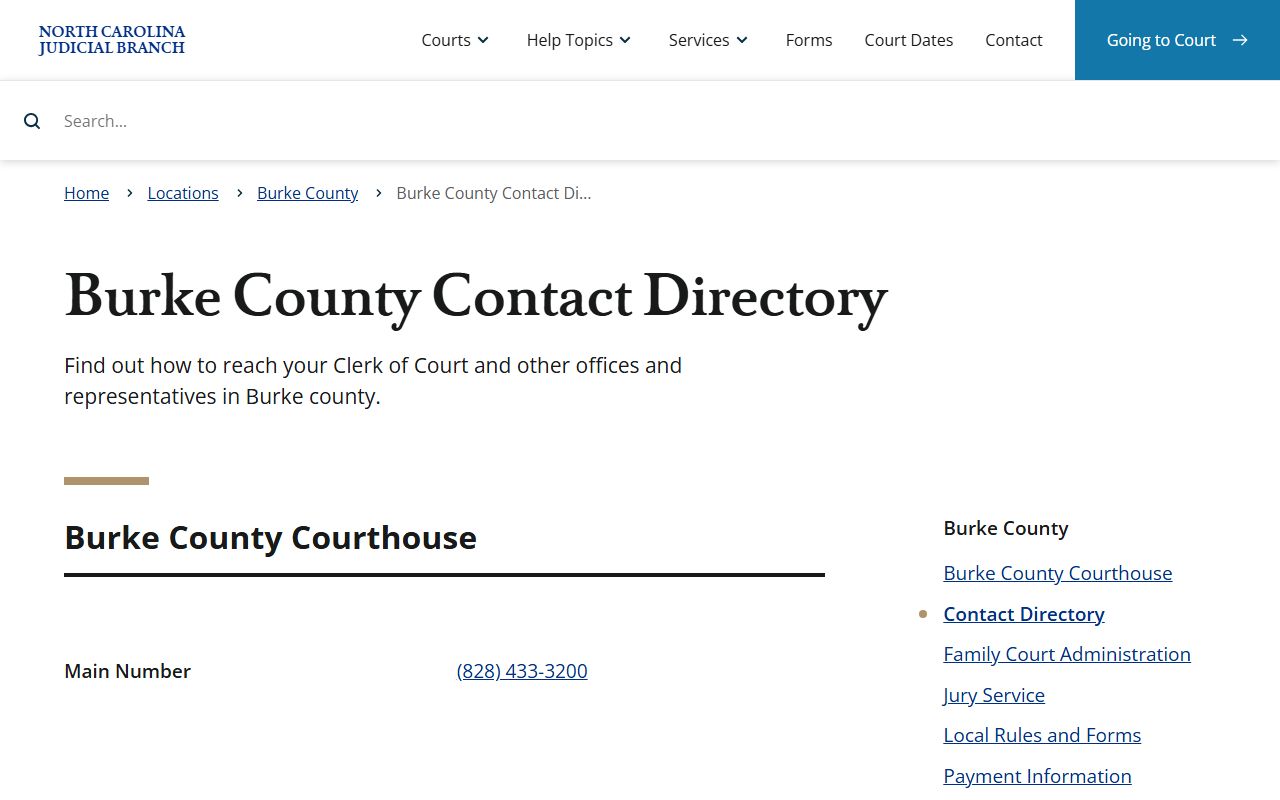
Use this directory for current courthouse numbers and office routing before visiting or mailing case-record requests.
Restricted Burke County Court Records
North Carolina public-record law begins broadly under N.C. Gen. Stat. § 132-1, but criminal-investigation and intelligence records have a major exception under § 132-1.4. Court records are handled through the Judicial Branch and clerk, while police investigative files, jail records, and booking photos may follow different rules. Juvenile matters, sealed records, expunged records, protected victim information, and ongoing investigations can be restricted or withheld from public display.